
Resilience
Behind an LED wall: 28 panels, 4 cables, a single HDMI input, and a plan B
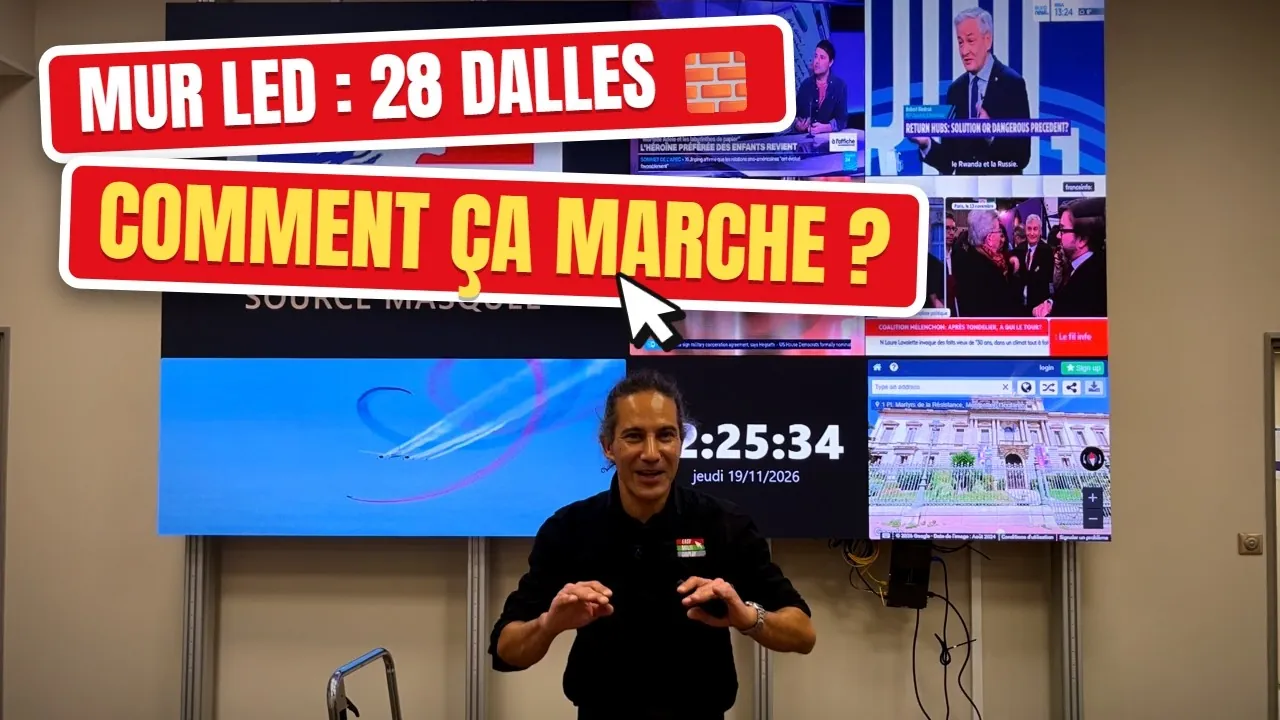
Final adjustments on the Hérault COD LED wall in Montpellier. We take the opportunity to show what is behind it, cable by cable.
28 panels, 4 cables
The wall: 28 panels of 50 x 50 cm, i.e. 4 rows of 7. Behind it, only 4 network cables (RJ45), one per row. We unplug one: the top row goes dark.
One controller, a single HDMI cable
These 4 cables leave from a controller. At its input, a single HDMI cable. We unplug it: the whole image goes dark. We plug it back in: the controller spreads the image across all the panels.
This HDMI cable comes from our CollectivView solution, which composes the wall display, notably with video capture. In the video, one of the captured sources is deliberately hidden: it is the surveillance cameras.
Plan B: a simple PC
The typical case: you just want to watch a sporting event, a football match or a swimming competition. A small HDMI selector, with its remote control: you switch from source 1 to source 5, and a simple PC is displayed across the whole wall.
And if a service goes down on the CollectivView side? Same reflex: you plug in a simple PC, and it is displayed directly on the video wall. A simple PC is therefore enough to run the wall.
No signal at all? The controller displays a standby message, recorded in advance.
Taking back control
To return to CollectivView, you press button 1 again: the signal travels from the server room to the selector, goes up to the controller, which spreads it across the wall with its 4 cables.
A simple signal path that you can follow cable by cable, and a fallback within reach: this is how we design a control room.
Software and hardware, LED walls included. A project? Guy Condamine will answer you directly: Guy@easymultidisplay.com, +33 6 79 07 55 19.